
The Database Revolution You've Been Waiting For 🚀
MongoDB's flexibility. PostgreSQL's power. GraphQL's elegance. One server.
Modern backend development is unnecessarily complex. You need MongoDB for flexibility, PostgreSQL for relationships, GraphQL servers for APIs, ORMs to bridge the gaps... It's a maze of dependencies, configuration, and overhead.
SyndrDB brings it all together in one powerful, zero-dependency server that speaks both SyndrQL (our SQL-inspired language) and GraphQL natively. With SyndrDB, you don't need an ORM : migrations are built-in, relationships are first-class citizens, and JSON is the native data format. Neither do you need a graphQL Server, as SyndrDB has a graphQL native interface!
Purpose-built tools and libraries that power the SyndrDB experience.
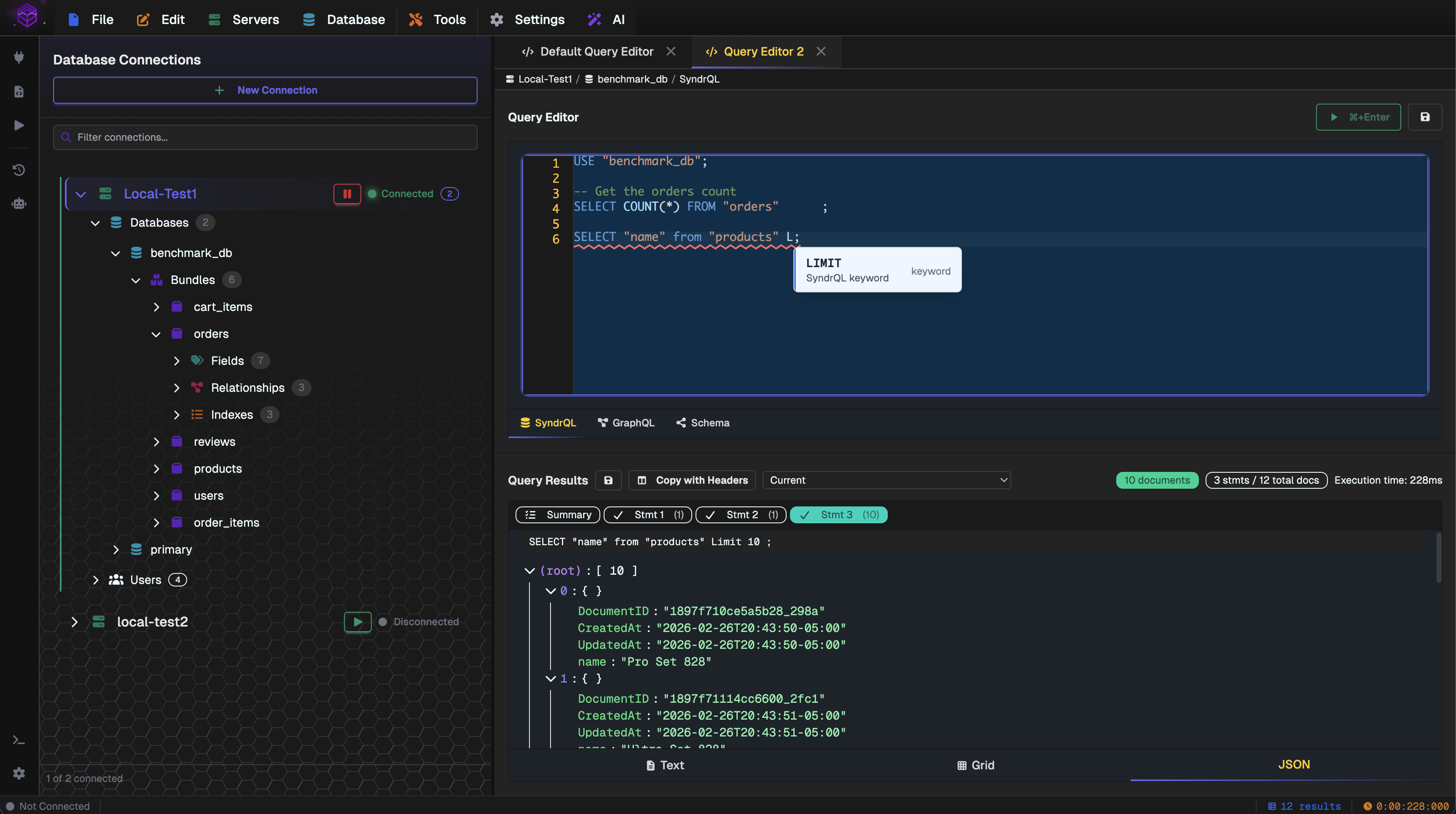
The professional cross-platform desktop IDE for SyndrDB. Custom canvas-based code editor, interactive schema diagrams, AI assistant, and plugin system.
The SIMD acceleration library powering SyndrDB's performance. AVX2 and NEON instructions with automatic CPU feature detection.
High Velocity JSON — a pure Go, zero-CGO JSON library with SIMD acceleration. Drop-in replacement for encoding/json.
No GraphQL server setup. No schema stitching. It just works.
SyndrDB Holds its own when compared to modern databases.
Hash Index Lookups
110000 QPS
B-Tree Range Queries
45000 QPS
Complex JOINs
25000 QPS
GraphQL Queries
32000 QPS
Document Writes
55000 Docs Per Second
Benchmarked on Apple M3 Pro (ARM64). Your mileage may vary.
SyndrDB borrows battle-tested concepts from the best databases:
| From PostgreSQL | From MongoDB | From GraphQL |
|---|---|---|
| ✓ B-Tree & BRIN indexes | ✓ Flexible schemas | ✓ Type-safe APIs |
| ✓ Cost-based query planner | ✓ Document storage | ✓ Field selection |
| ✓ MVCC & isolation levels | ✓ JSON responses | ✓ Nested queries |
| ✓ Triggers & views | ✓ Horizontal scalability* | ✓ 5-layer query security |
| ✓ Prepared statements | ✓ Foreign key relationships | ✓ Introspection |
Then we added: SIMD acceleration, smart caching, migration versioning, triggers, materialized views, 140+ metrics, and native GraphQL—all in pure Go with zero external dependencies.
*Cluster mode, replication, and other advanced features coming in the enterprise version
Make your development efforts less complicated and easier to maintain, while releasing faster than ever!
Community Edition is Free and open source.
| Feature | Community Edition | Enterprise Edition |
|---|---|---|
| Core SyndrQL query language | ||
| GraphQL interface | ||
| ACID compliance with WAL | ||
| B-Tree, Hash & BRIN indexes | ||
| Partial, expression & covering indexes | ||
| Relationships & foreign keys with CASCADE | ||
| Views & materialized views | ||
| Triggers (BEFORE/AFTER) | ||
| MVCC with 4 isolation levels & savepoints | ||
| Prepared statements & server-side cursors | ||
| Built-in functions (string, math, date/time) | ||
| EXPLAIN / EXPLAIN ANALYZE | ||
| 140+ monitoring metrics | ||
| RBAC security & audit logging | ||
| Migration system | ||
| Backup & restore with compression | ||
| Full-text search | ||
| Cluster mode (distributed) | ||
| Real-time subscriptions | ||
| Multi-region Replication | ||
| Federated GraphQL instancing | ||
| Hot Backups | ||
| Embedded Code Execution/Webhooks | ||
| Advanced observability tooling |
Automatic open source conversion:
On [4 years from v1.0 release], this version automatically converts to Apache License 2.0.
Commercial licensing:
Need a commercial license (Enterprise Edition)? (COMING SOON)
Stop managing databases. Start building products.
SyndrDB was born out of the sheer annoyance that setting up a backend for a modern web app. Every backend was the same: Postgres for data store, some ORM to convert the tables to objects, and a GraphQL API. It seemed like a lot of extra infrastructure just to change the shape of the data from tables to JSON, and change the access from SQL to GraphQL. Those transformations offer no value, just change how the developers worked with the data. So why not just have a database that stores data in JSON document format, but natively speaks GraphQL? Thus SyndrDB was born.